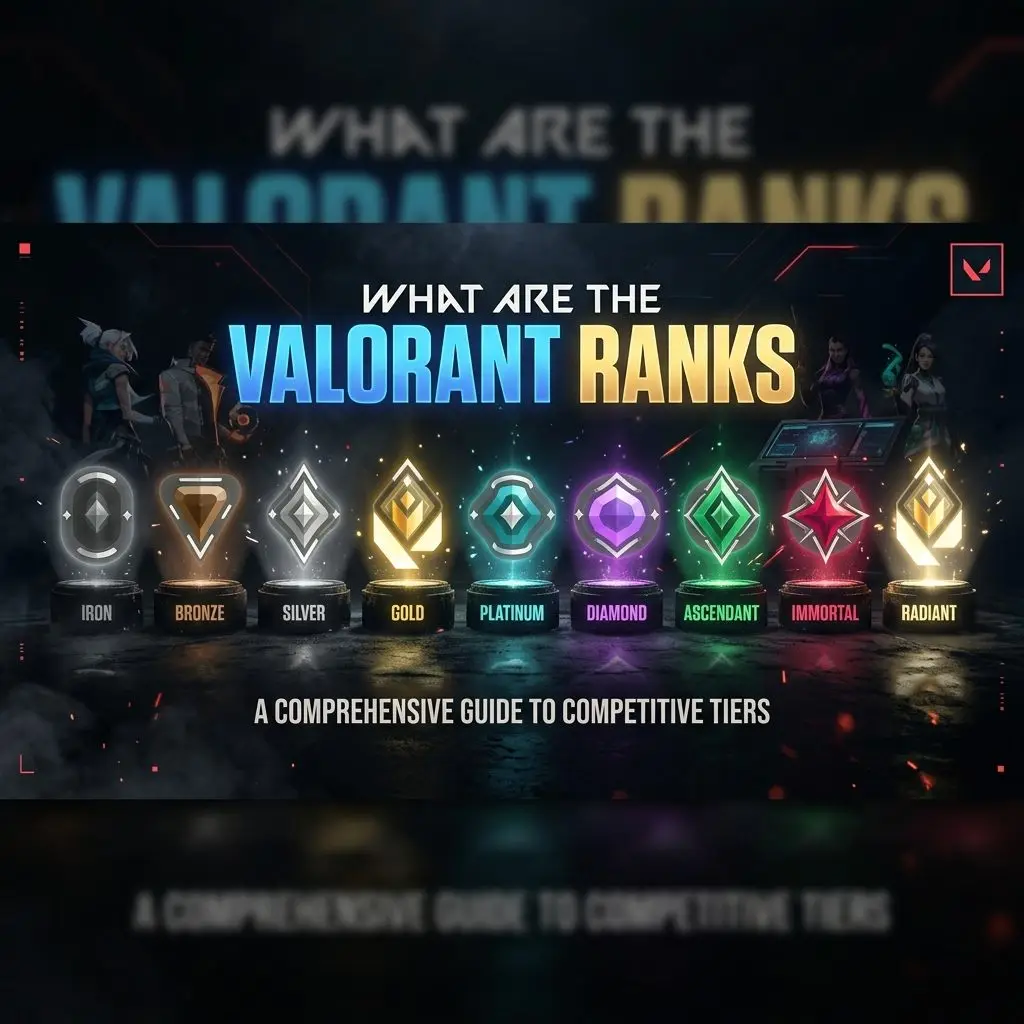
Valorant ranks exist to answer one question for the matchmaker: how good are you, relative to everyone else queuing right now? Every player in Competitive carries a rank — one of 9 tiers from Iron to Radiant — so the game can build lobbies where both teams have a realistic shot at winning.
Ranked vs. Unrated: why ranks only exist in one queue
Rank is a Competitive-only concept. Unrated matches don’t display a rank at all — Valorant still uses an internal skill estimate to build reasonably fair lobbies, but there’s no visible tier attached to it, no promotions, and nothing that resets each Act. If you’ve only played Unrated or Spike Rush, you won’t have a rank until you queue Competitive and complete placements.
Ranked terms, explained
A short glossary for anyone new to the system:
- Rank — your current tier, from Iron to Radiant.
- Division — the 1–3 sub-level within a rank (Radiant has none).
- RR (Rank Rating) — the 0–100 bar that fills as you win; hitting 100 promotes you.
- MMR (Matchmaking Rating) — a hidden number the matchmaker actually uses to build lobbies; your visible rank trails it.
- Act — a roughly two-month competitive period; ranks soft-reset between Acts.
- Season — a full year of competitive play made up of six Acts (Riot’s replacement for the older Episode system); Season boundaries bring the larger rank reset.
- Placements — the 5 matches that assign your first rank of a new reset.
Rank vs. account level — not the same number
These two get confused often. Account Level is simply how long you’ve played — it unlocks Competitive at Level 20 — while rank measures skill and only exists inside the ranked ladder. A Level 200 account can still be Iron; a fresh Level 20 account can place into Gold if their placement matches go well.
Where this fits together
For the full ordered list of all 9 ranks and how divisions stack up, see Valorant Ranks in Order. For how RR and MMR actually move week to week, read Valorant Ranks Explained. Playing with friends of different ranks? See which ranks can queue together. You can also jump straight to the interactive rank breakdown on the homepage.