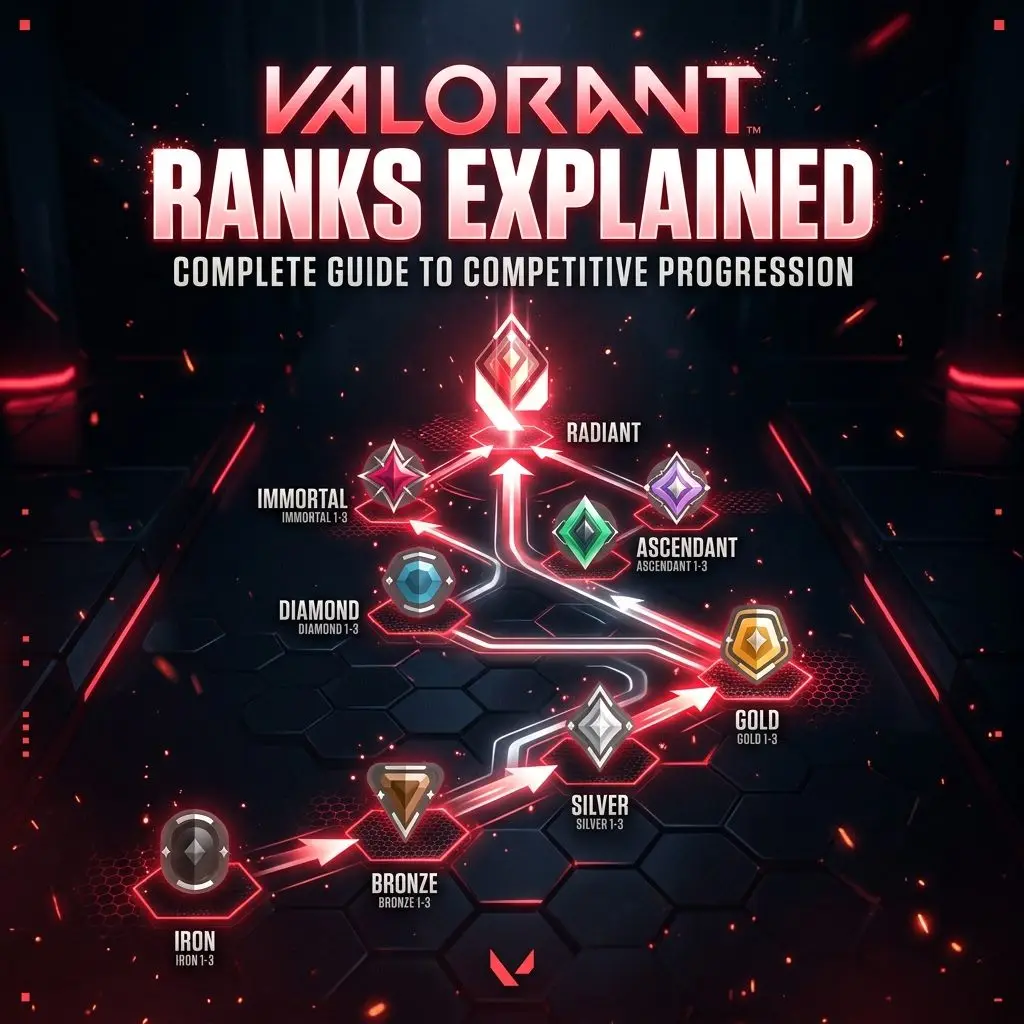
Valorant’s ranked system is built around two key ideas:
- Rank Rating (RR): the visible number you gain or lose after matches.
- Matchmaking Rating (MMR): a hidden skill estimate that influences who you play and how fast you gain RR.
RR vs. MMR (the practical difference)
If your hidden MMR is higher than your displayed rank, you’ll usually:
- gain more RR for wins
- lose less RR for losses
If your MMR is lower than your displayed rank, the opposite tends to happen.
Why RR and MMR can diverge
MMR and displayed rank drift apart for a few common reasons:
- Fresh placements: a new account’s MMR calibrates faster than its visible rank, so rank often jumps quickly right after your first 5 placement matches as the visible number catches up.
- Win or loss streaks: MMR reacts to recent results faster than RR does, which is exactly why a hot streak tends to boost your RR gains before your rank itself changes.
- Party queue: queuing with higher- or lower-skilled friends changes your lobby’s difficulty without directly changing your own RR each game, which can pull MMR and rank in different directions over time.
Placements and resets
- New accounts unlock ranked after reaching Account Level 20.
- Each yearly Season brings a heavier reset; the Acts within it feel like a soft reset by comparison.
- Placements are meant to re-calibrate you quickly based on performance and results.
Riot retired the old Episode/Act naming in favor of yearly Seasons in 2025 — the underlying reset pattern didn’t change, just the label. See Valorant Ranks History for the full timeline.
Queue restrictions (party play)
Queue rules depend on party size:
- Duos/trios have rank disparity limits.
- 5-stacks have no rank restrictions, though the matchmaker weights the lobby toward your party’s strongest player — so full parties often face tougher opponents.
How to climb reliably
The simplest consistent plan:
- Pick 1–2 main agents and learn them deeply.
- Warm up before ranked (Range + a Deathmatch).
- Focus on trading and playing numbers.
- Track errors after each session (two mistakes max to fix next time).
Related guides
For role-specific climbing advice, see How to Rank Up by Role. For the full tier list from Iron to Radiant, see Valorant Ranks in Order. New to ranked terminology? Start with What Are the Valorant Ranks.