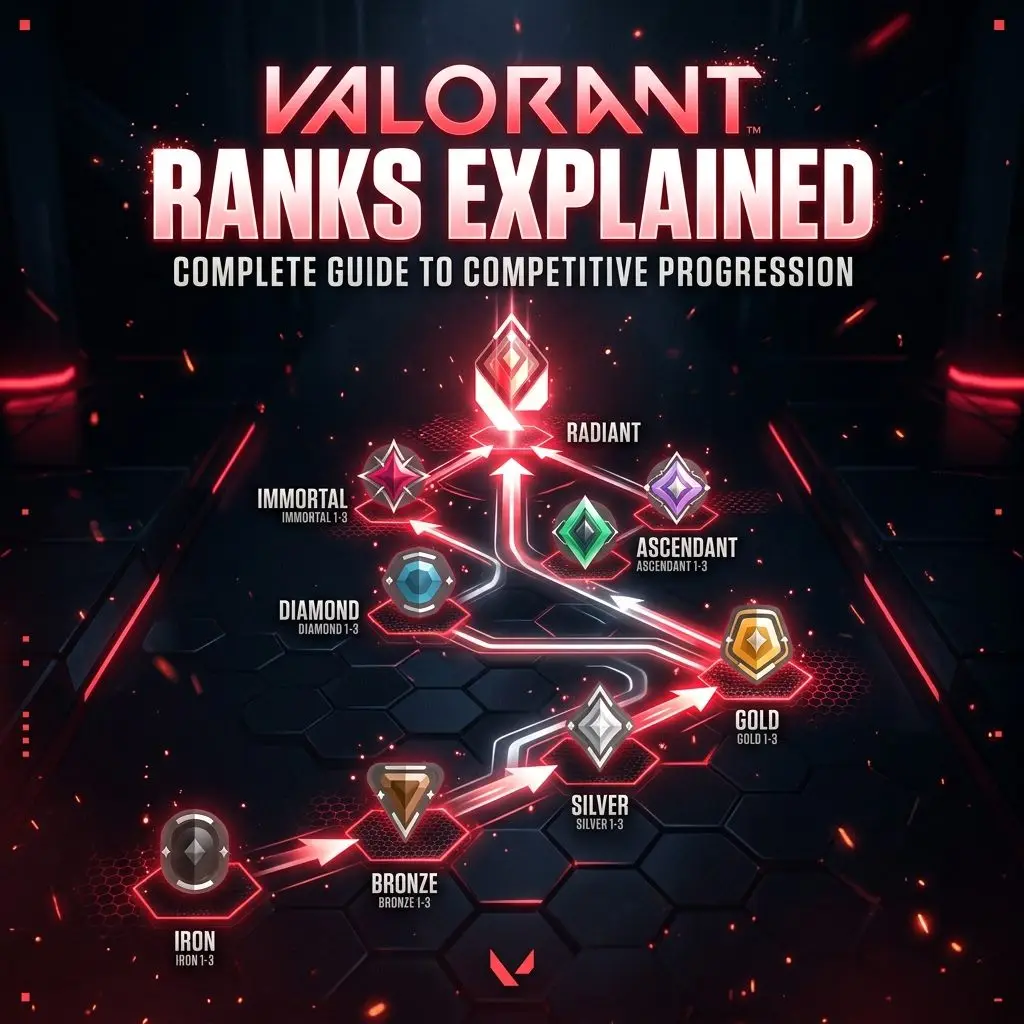
Valorant caps how far apart your party’s ranks can be so that Competitive queue stays fair — but the exact rule depends on your rank and your party size. Here’s the full breakdown.
The general rule: disparity shrinks as ranks climb
At lower ranks, Riot allows a wider gap between party members, and that gap narrows steadily the higher you climb:
| Your rank range | Typical party disparity allowed |
|---|---|
| Iron / Bronze | Can party up to roughly Silver |
| Silver | Can party up to roughly Gold |
| Gold | Can party up to roughly Platinum |
| Platinum – Diamond | About one full rank apart (a Platinum 1 and Diamond 3 can still queue together) |
| Ascendant – Immortal | Roughly one division apart — an Ascendant 3 can party with an Immortal 1, but not higher |
| Immortal – Radiant | Solo, duo, or full 5-stack only — no trios or 4-stacks |
These bands aren’t published as exact hard numbers by Riot and can shift slightly patch to patch, but the pattern holds: disparity limits get tighter the higher you climb, and they exist to stop a high-rank player from dragging a much lower-rank friend into lobbies they’re not ready for (or the reverse — smurfing).
Duo queue
Duos have the most generous disparity limits of any multi-player party size. Two Iron players can duo with a Gold-range friend; the gap narrows automatically as you approach Immortal, where duo is one of only two party sizes still allowed.
Trio queue (3-stack)
Trios follow the same shrinking-disparity logic as duos, but stop working entirely at Immortal and Radiant — those two ranks can’t form a 3-player party at all. If you’re climbing with two friends and one of you hits Immortal, that group has to either drop to a duo, add two more for a full 5-stack, or split up.
4-stacks
A 4-player party (“valorant ranked 4 man”) follows the standard disparity table above and, like trios, becomes unavailable once any member reaches Immortal or Radiant.
5-stacks
Full 5-player parties are the one grouping with no rank disparity limit — any combination of ranks can queue together. The trade-off is matchmaking weight: the game builds the lobby around your party’s strongest player, so a 5-stack with one Radiant and four Golds will face opponents closer to Radiant-level, not Gold-level. Riot also applies RR reduction penalties to five-stacks that mix high ranks with much lower ones, so the lower-ranked players in that stack earn noticeably less RR per win than they would solo-queuing.
Why Immortal and Radiant lose trios and 4-stacks specifically
Riot restricts party sizes of 3–4 at the top two ranks specifically to limit boosting and smurfing at the level where it matters most competitively — a small squad of high-rank players carrying one weaker account is much easier to pull off than doing it inside a full 5-stack, where matchmaking weighting punishes the mismatch anyway.
Premier is a different system
If you’re wondering how this applies to Valorant Premier (“ranks for premier valorant”), it doesn’t — Premier isn’t restricted by individual competitive rank at all. You register a fixed 5-player roster, get placed into a division based on your team’s combined skill, and play a season of scheduled matches toward a point total. Your Competitive rank keeps updating in the background, but it has no bearing on who you’re allowed to roster in Premier.
Related guides
For how RR, MMR, and promotions work, see Valorant Ranks Explained. For the full tier list, see Valorant Ranks in Order.